
| Genotype ID | Genotype Name | Genotype Characteristics |
|---|---|---|
| P1 | Panniyur-1 | High yielding hybrid; high oleoresin (11.8%) long spikes & bold berries |
| P2 | Panniyur-2 | High oleoresin and high piprine |
| P3 | Panniyur-3 | Long spikes & bold berries |
| P4 | Panniyur-4 | Llong spike with twisted and bend spike small sized berries |
| P5 | Panniyur-5 | Long spikes |
| P6 | Panniyur-6 | Steady and stable yielder tolerant to drought and adverse climatic conditions |
| P7 | Panniyur-7 | Long spike; high piperine (5.6%) |
| P8 | Panniyur-8 | A drought tolerant variety with medium sized spike |
| P9 | Panniyur-9 | Drought tolerant genotype with excellent berry charecters and quality |
| P10 | Panniyur-10 | Good yielder with good berry charecters |
| P11 | Agali | Bold berries with high( 45-48%) dry recovery and high white pepper(37%) |
| P12 | Arka Coorg excel | Long spike and bold berries |
| P13 | Balankotta | Long spike medium sized berries and loose setting |
| P14 | Chumala | Spikes short to medium; good fruit set; medium yield and quality. |
| P15 | Acc: 4226 | Drought tolerant accession |
| P16 | Acc: 7211 | Drought tolerant accession |
| P17 | IISR-Girimunda | Suitable for high elevation and plains in the country |
| P18 | HP 2173 | long spike and compact setting; high yielder |
| P19 | Karivilanchi | Medium length spike with Oblong with yellowish berries |
| P20 | Acc 7548 (Kottanadan) | Medium spike length with medium berry sice and hashigh quality |
| P21 | IISR-Malabar Excel | Recommended for all pepper tracts in the country including high elevations. |
| P22 | Malligesara | Medium length berries with compact setting and medium sized berries. |
| P23 | Naraykodi | Low piperine (<2.59) and little oblong berries |
| P24 | Nedumchola | Small spike with small berries |
| P25 | P24(O4) | Phytoprhora tolerant |
| P26 | Panchami | Twisted spike; late maturing variety with good setting percentage |
| P27 | Piper colubrinum | Complete resistance to Phytopthora with compact spike |
| P28 | Piper nigrum female | Wild black pepper with partial setting spike and bold berries |
| P29 | Piper nigrum male | With black pepper with only male flower |
| P30 | PLD-2 | Late maturing ; high quality cultivar |
| P31 | Pournami | Nematode tolerant variety with bold berries and sloose setting |
| P32 | IISR-Shakthi | Tolerant to Phytophthora capsici; moderate yielder |
| P33 | Subhakara | Suitable for all pepper growing regions in the country. |
| P34 | Sreekara | Suitable for all pepper growing regions in the country. |
| P35 | Srilankan PLS CS 65 | Exotic collection |
| P36 | Thekkan? | Multi branched spike with varying berry size and maturity. |
| P37 | IISR-Thevam | Field tolerant to Phytophthora capsci |
| P38 | Vadakkan | A naturaly triploid genotype with medium spike and bold berries |
| P39 | Vijay? | A early bearing type |
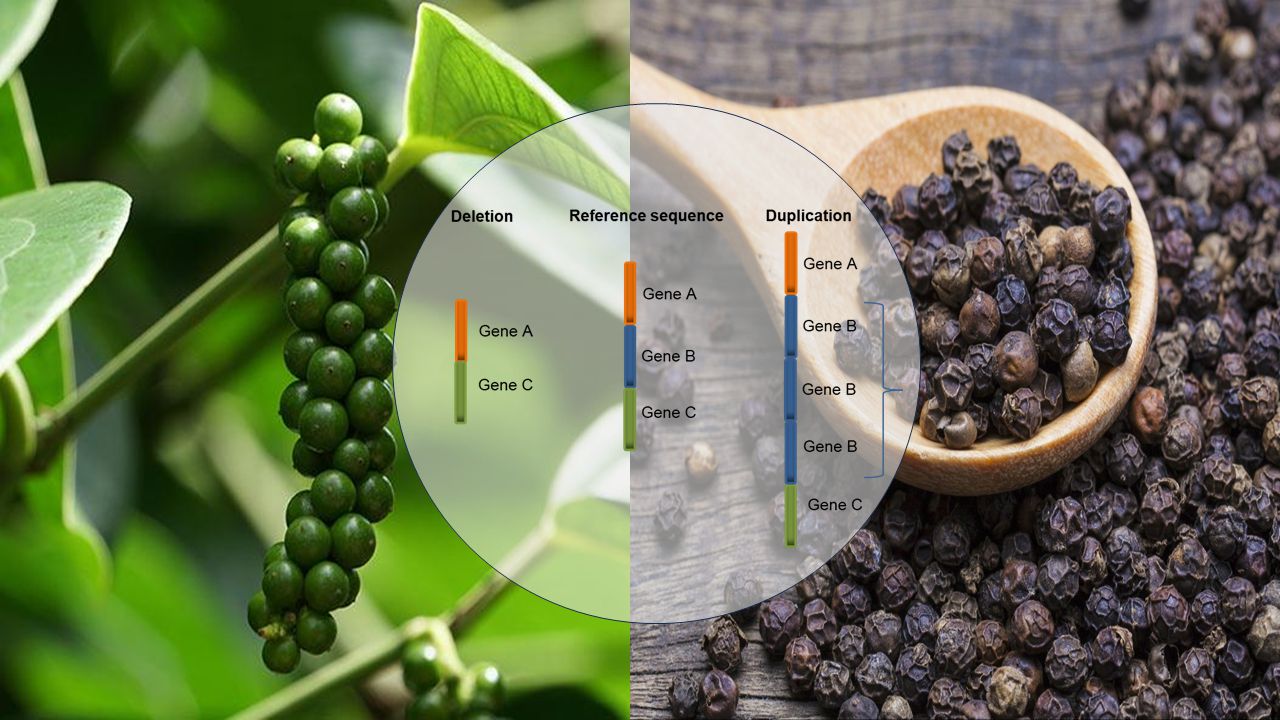
Black pepper (Piper nigrum L.), widely known as the "king of spices," is an economically significant crop belonging to the Piperaceae family. Beyond its culinary value, black pepper possesses diverse applications in fragrance, traditional medicine, and food preservation due to its bioactive alkaloid, piperine. Piperine exhibits anti-inflammatory, antioxidant, analgesic, antipyretic, antimicrobial, digestive, and cytotoxic properties, underscoring its global importance in food and pharmaceutical industries.
BpCNVDb is a dedicated database for exploring copy number variations (CNVs) in black pepper, derived from whole-genome resequencing (WGS) data of 39 genotypes collected across India. A total of 159,390 CNVs and 11,360 CNV regions (CNVRs) were identified by comparing these WGS datasets with the reference genome. This resource provides chromosome-wise visualization of CNVs and CNVRs, facilitating genotype-specific structural variation information with its functional implications.
BpCNVDb serves as a valuable platform for genetic studies, including genotype identification, genetic diversity assessment, and marker-trait association analysis. By integrating CNV data into breeding programs, researchers can use this database for the identification of genetic variations associated with agronomic traits, aiding in the development of improved black pepper cultivars. The database offers an intuitive interface to assist researchers in retrieving and analyzing CNV information, supporting studies in functional genomics, evolutionary biology, and plant breeding
 ICAR-IARI New Delhi - 110012 |
 ICAR-IISR Kozhikode - 673012 |
 ICAR-IASRI New Delhi - 110012 |
Website Visit Counter |